I grew up with National Geographic in the house. My dad collected the magazines, and the imagery was always the thing. The world showed up in our living room once a month, and it showed up in pictures first.
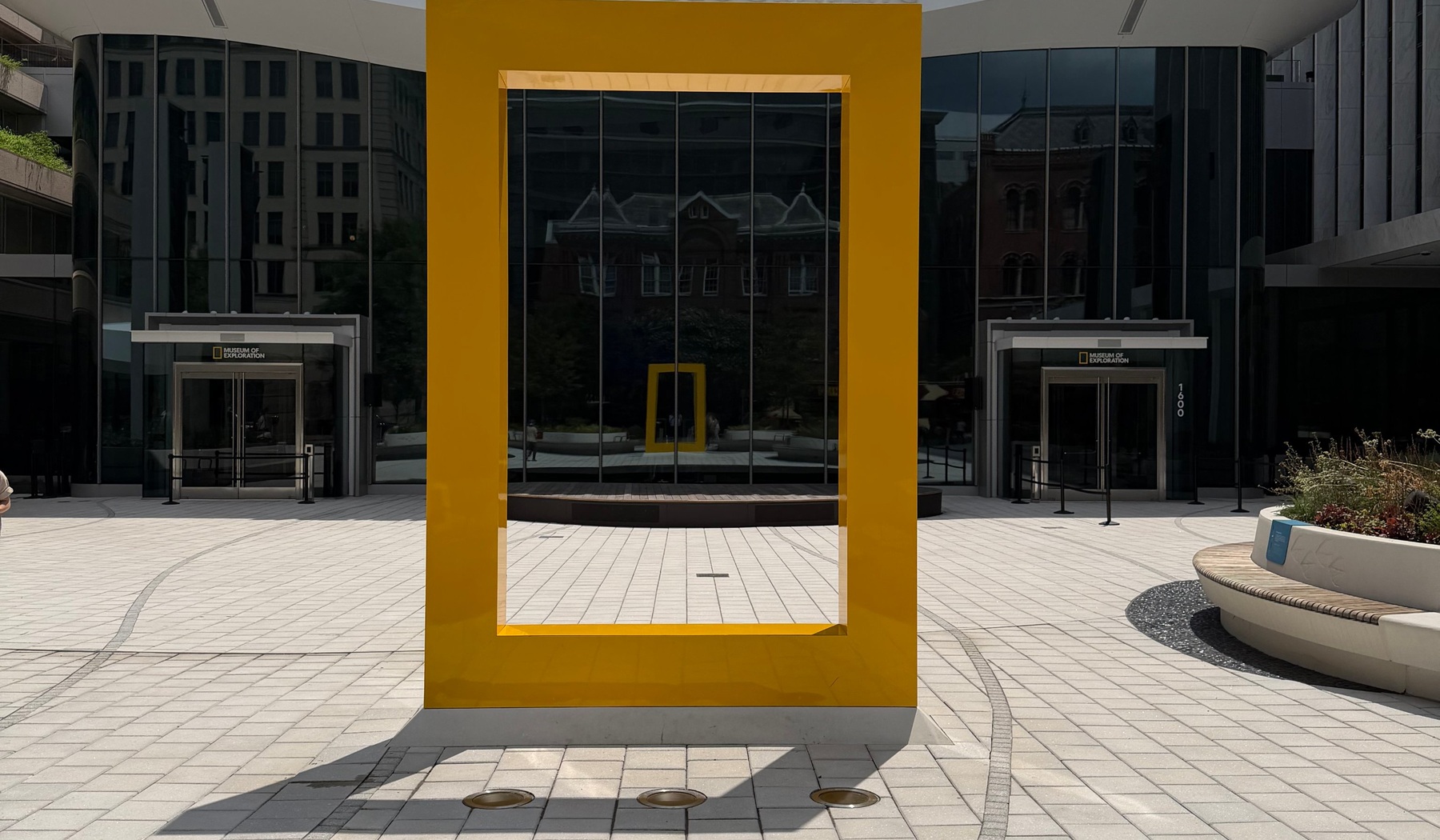
So walking up to the museum in Washington, D.C., the first thing that got me was the yellow rectangle. That frame is one of the most recognizable marks on earth. Outside the building it stops being a logo and starts being a doorway. Simple. Confident. It does exactly what a mark should do.
The familiar yellow frame becomes an architectural invitation.
The display is the moment
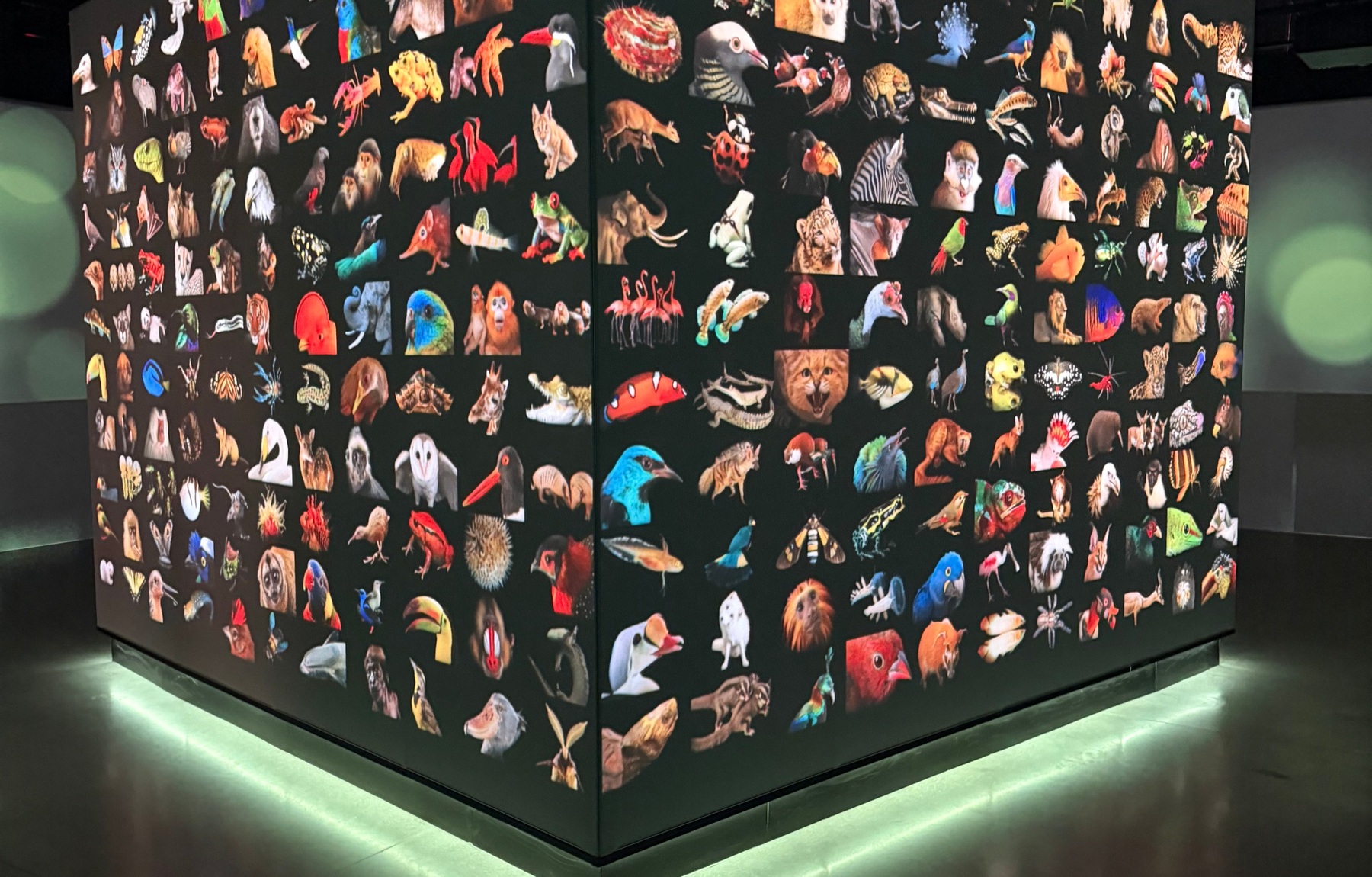
Inside, the thing that stopped me cold was the cube.
Joel Sartore’s Photo Ark, rendered as a glowing monolith in a dark room, thousands of animal portraits tiled across every face. A visual stunner. I stood there thinking about those magazines on my dad’s shelf. This is what they were always trying to be.
Here is the designer read, and I mean it as the highest compliment: anyone can hang photographs. Visualization grabs your attention, but the display of that content is the moment. A dark room and a glowing cube turn a collection into an encounter. You do not simply look at it. You stand inside the idea.
The Photo Ark cube turns an archive of portraits into a single, immersive encounter.
The moment stands on years of work
And then there is what lives beyond the moment.
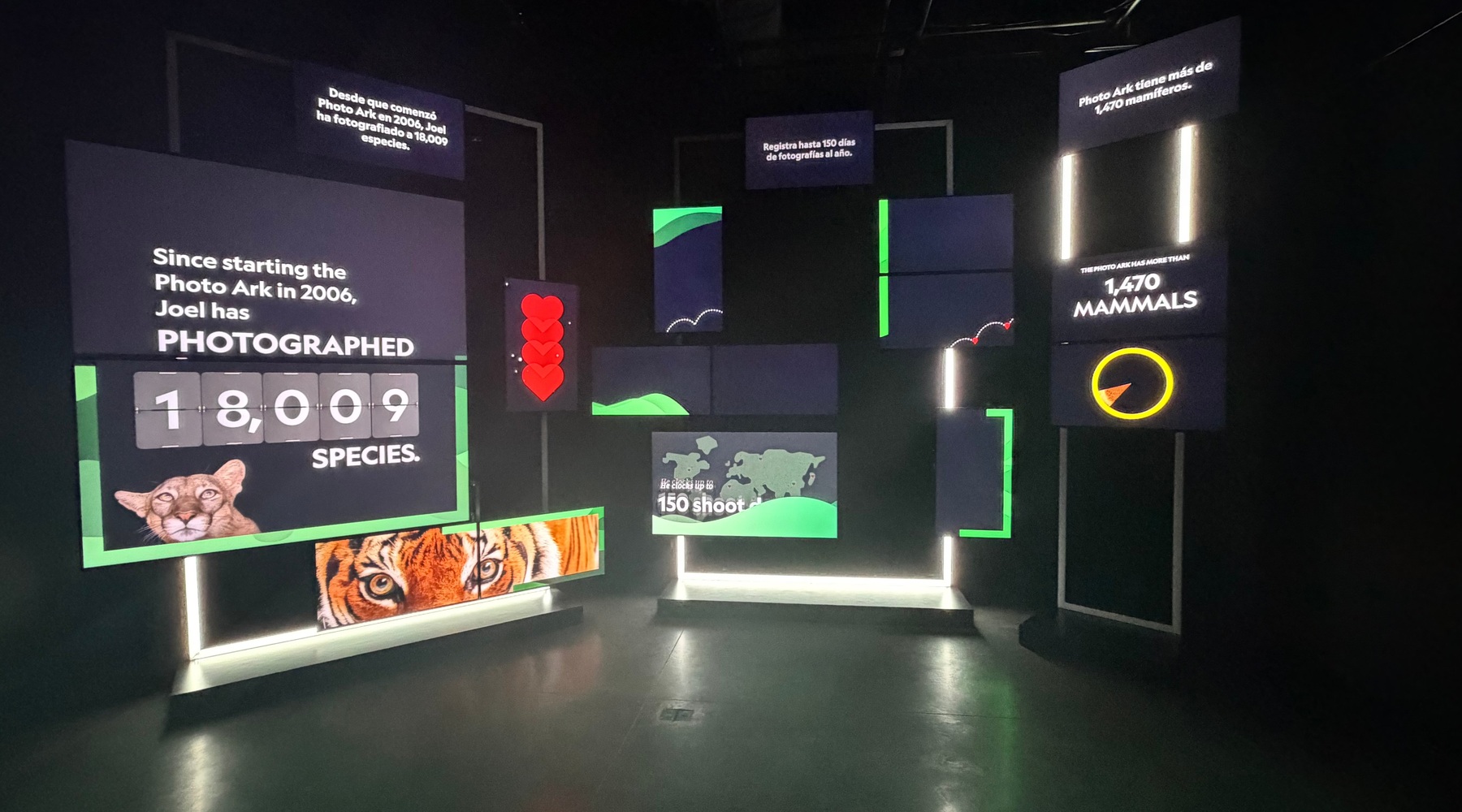
18,009 species photographed. 150 shoot days a year. The project began in 2006. Every face on that cube represents work you never see. The flights, the waiting, and the trust required to capture a living creature one frame at a time. The moment you feel in that room stands on years of mornings nobody witnessed.
That is the part I cannot stop thinking about. We talk about moments like they appear out of nowhere. They do not. The best ones are built quietly, over years, by people who care enough to keep showing up.
The visible moment is backed by years of patient, sustained work.
The next chapter could become iconic
They did a great job here. And the part that excites me is what comes next. As this expands, it has the potential to bring those magazines to life. Not a bigger display. A living one. That is how something becomes iconic.
Go see the cube. Then think about everything standing behind it.
On the morning of November 1, 1755, the churches of Lisbon were full. It was All Saints’ Day, and the city was at worship.
Then the ground moved.
What followed was one of the deadliest earthquakes in recorded history. The shaking lasted minutes. Then came the tsunami. Then the fires, which burned for days. Tens of thousands of people died, and the center of one of Europe’s great cities was erased in a single morning.
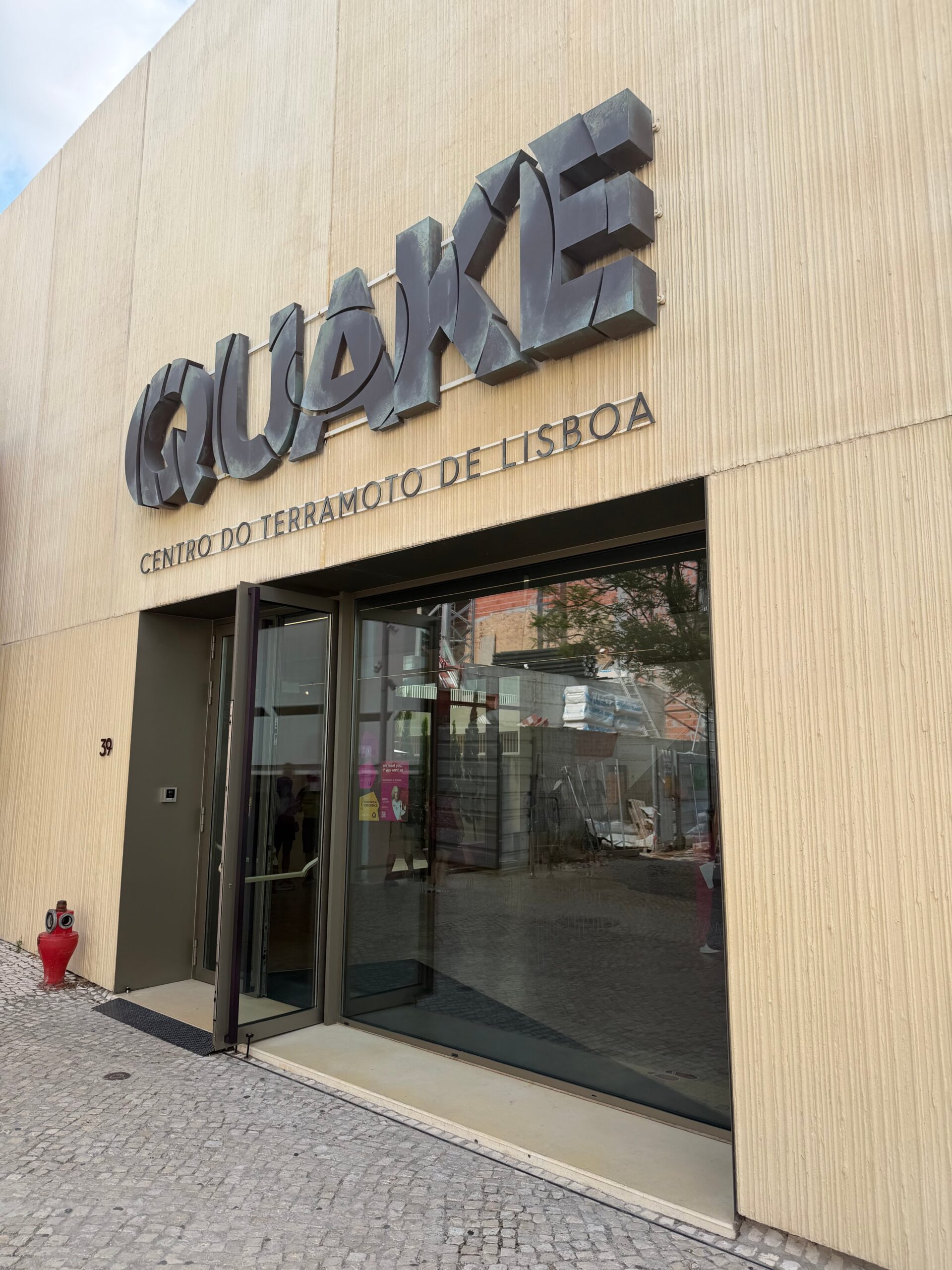
There is now a museum in Belém, a district of Lisbon, built around that morning. It is called QUAKE, and it is one of the most instructive pieces of experience design I have studied in years. Not because of its technology, though the technology is excellent. Because of the order in which it teaches.
It was designed by Jora Vision, a Dutch experience design firm that carried it from concept through turn-key production, and it earned a TEA Thea Award for Outstanding Achievement in the historical experience category. I mention that because the people who judge this work for a living recognized what the design was doing, which is exactly what this post is about.
I walked through it with my family on our trip to Portugal, and I watched the thesis work in real time on my own kids.
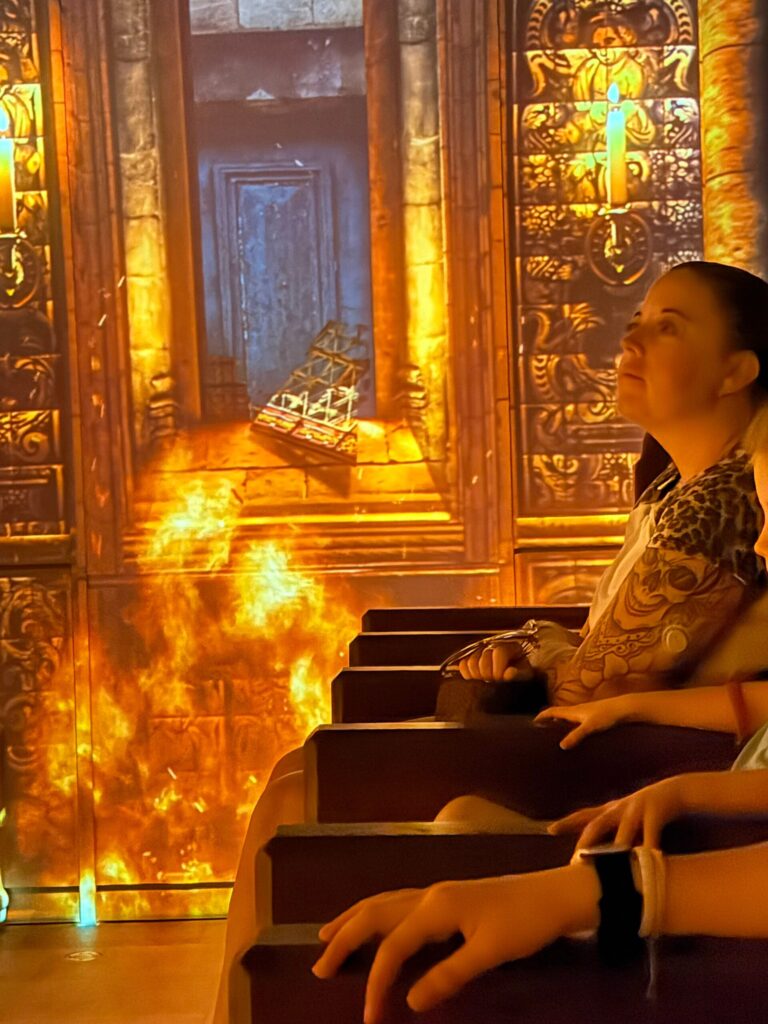
The visit is a ninety minute journey through nine timed scenes. You move through rooms the way the story demands, not the way your curiosity wanders. And there is a story, not just a sequence. You meet a character called the Professor in an abandoned laboratory, and you are sent back in time on a mission to recover missing documents. You walk a recreated Lisbon street as it looked in 1755, alive and ordinary, full of the small details that make a place feel real before anything happens to it. You meet the heroes and villains of that era. Then the church.
You sit in a pew. The ground begins to move. The church collapses around you.
Afterward you walk through the destroyed city, past what is left of what you just saw intact. And the journey ends with the rebuild, with how Lisbon answered the worst morning in its history by deciding what kind of city it would become next.
Video mapping, simulators, sound design, even scent. The full sensory register, deployed with restraint. Nothing in the experience exists to show off. Everything exists to put your body inside the event before your mind is asked to understand it.
That sequencing is the entire thesis, and it is the opposite of how most education works.
Most museums, most classrooms, most corporate training, most onboarding decks, they all lead with information and hope the feeling follows. Here are the facts. Here is the timeline. Here is the diagram of the tectonic plates. Please care about this now that you know it.
QUAKE reverses the order. It gives you the feeling first and earns the right to teach second. By the time the science arrives, how earthquakes start, how tsunamis form, why Lisbon was uniquely vulnerable, what happened later in San Francisco and Japan, you are not receiving information. You are receiving answers to questions your body already asked.
That is a completely different kind of learning. Information without emotion is trivia. It is stored shallow and retrieved never. Emotion without information is just a thrill, vivid for a day and gone by the week. But emotion first, then information, that sequence builds something durable. The feeling creates a shelf, and the facts finally have somewhere to sit.
The designers said this out loud. Jora Vision’s creative director described the central challenge as holding two demands at once. The experience had to be educationally relevant, historically and scientifically accurate, and respectful of a real catastrophe. And it had to break completely from the traditional museum, built around a real plot with a beginning, a middle, and an end. His test for success was that visitors would leave having played a role on an emotional level. Not having seen an exhibit. Having played a role. That sentence could hang in every design studio in our industry.
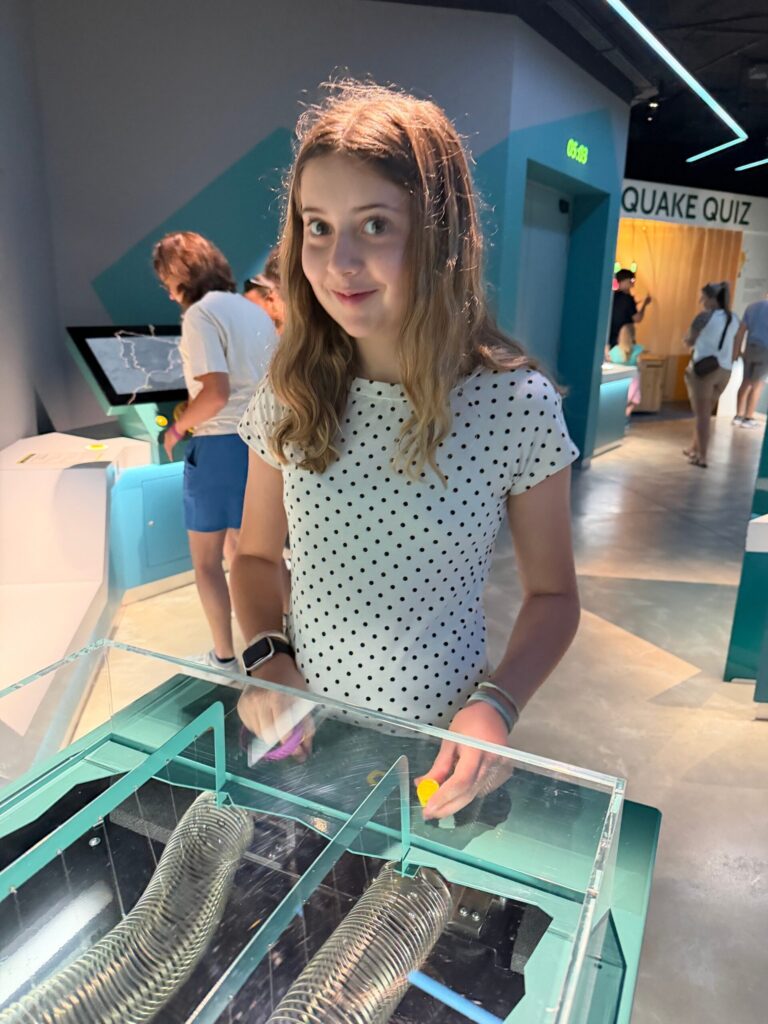
The people who built QUAKE clearly understood this, because they did not stop at the emotional architecture. They built a genuine educational engine underneath it. There is a game inside the experience called Treme-Treme, developed with the Instituto Superior Tecnico in Lisbon. It lives at one of the interactive stations, it ends with a quiz, and its effectiveness is studied in partnership with actual schools. The full version is free online, on computers, phones, and tablets.
Read that again. A museum built a learning tool with a university, validated it with schools, and gave it away. That is not a gift shop strategy. That is an institution deciding that its job does not end at the exit.
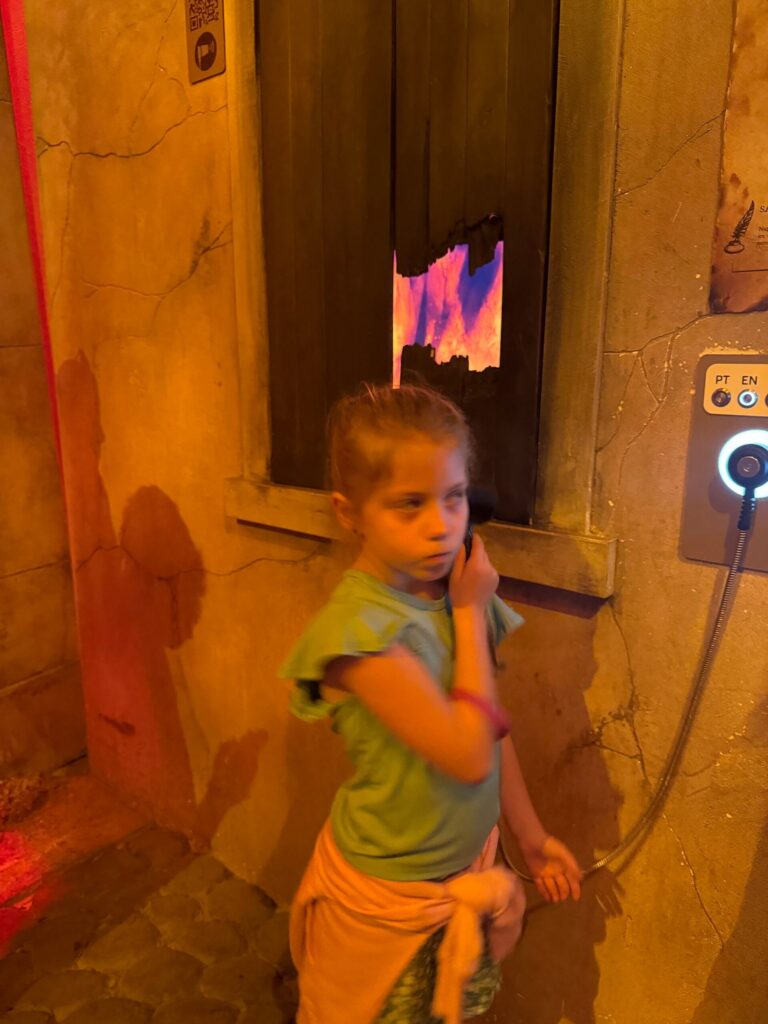
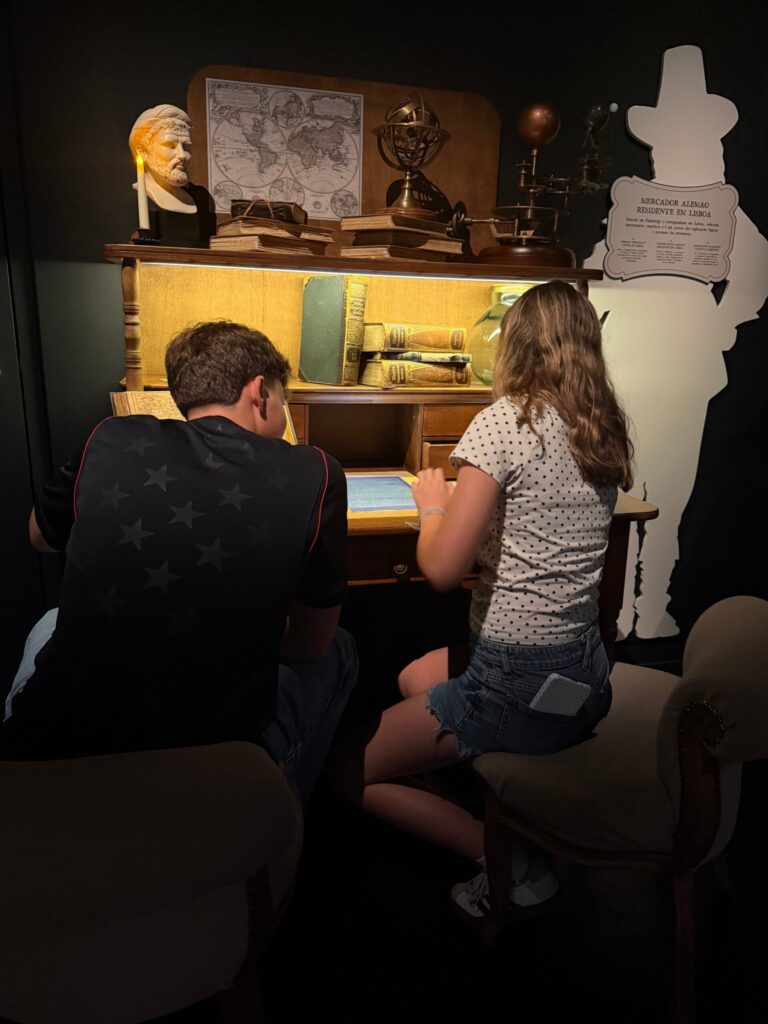
I watched it happen. One of my kids with a handset pressed to her ear at a cracked wall, listening to the city burn on the other side. Two others hunched over the Professor’s desk, working the documents like it mattered. Nobody told them to care. The design did that.
The RFID wristbands every visitor wears make the same point in hardware. The experience continues at home, after the visit ends. The exit is not the end of the design. It is a scene change.
And notice what they are actually teaching. Not just history. Preparedness. Risk literacy. The stated framework connects the experience to disaster management, mitigation, and readiness, aligned with the United Nations sustainability goals. The past is being used as a rehearsal for the future. A child who walks through QUAKE does not just know more about 1755. That child is fractionally more ready for whatever comes next. That is education with a purpose beyond itself.
There is also real craft in the dosage. The rooms are timed, so the pacing is controlled. The minimum age is six, and small children are kept out of the simulator. The intensity is calibrated the way a good show is calibrated, enough to be felt in the body, never so much that it becomes distress for its own sake. And the journey ends with the rebuild, which matters enormously. You do not leave inside the catastrophe. You leave inside the recovery. Horror, then hope, in that order, on purpose.
I keep coming back to a simple principle in my own work. Name the feeling first. Decide what someone should feel before you decide what they should know, and let the feeling do the structural work. QUAKE is that principle executed at institutional scale, about an event that happened two hundred and seventy years before I was born, in a city I was visiting for the week. And it worked on my kids anyway. That is what good design does. It crosses every boundary except the one that matters, the boundary between the experience and the person inside it.
Here is the leadership lesson underneath it, because there always is one.
Every organization I know leads with information. The strategy deck. The data. The rationale. The timeline. Then everyone wonders why nobody changed, why the message did not land, why the team nodded through the presentation and went back to doing what they were already doing. The information was correct. The order was wrong.
People do not change their minds because they were given better facts. They change their minds because they felt something that made the facts matter. The feeling is not decoration on top of the lesson. The feeling is the lesson’s delivery system. Skip it and you are mailing a package with no address on it.
QUAKE understands that a frightened body learns plate tectonics better than a bored mind ever will. The question worth carrying out of Belém is where else that applies. The classroom. The boardroom. The first day of a new job. Anywhere we need someone to truly understand something, not just accurately repeat it.
Nobody retells a plaque. They retell the pew shaking under them. They tell someone who was not there, and that person feels a version of it too, secondhand but real. That is the measure of any experience, what gets carried out of the room and into someone else’s imagination.
Teach the feeling first. The facts will follow, and this time they will stay.
It is not the ability to pick the right font or know which shade of white looks expensive. It is not an aesthetic sensibility you either have or you do not. Those are the surface-level readings of a word that runs much deeper than that.
Taste is the decision framework of someone who has cared enough, for long enough, to know the difference between what something is and what it could be. It is what lets you walk into a room and feel what is wrong before you can articulate it. It is the thing that makes you pause when everyone else is ready to move on. It is the quiet internal signal that says not yet when the room is saying good enough.
And here is what nobody tells you early in your career: taste is not a gift. It is not something you are born with or not born with. It is a practice. It is built the same way any real capability is built, through exposure, attention, repetition, and a willingness to be wrong in public long enough to finally be right.
You develop it by looking at a hundred versions of the same thing and asking yourself what separates the ones that land from the ones that almost land. You keep notes. Not because you are going to reference them later, but because the act of writing down why something works trains you to see it. You put yourself in rooms with people who see things you do not see yet, and you listen more than you talk. You argue about the details, the ones that feel small, because the small ones are where taste actually lives. You train your eye the way an athlete trains a muscle. Not in bursts. In reps, over time, until the response becomes instinct.
That is the first half of the work.
The second half is harder. The second half is having the backbone to act on it.
This is where most people stop. They develop the taste. They can see the gap between what something is and what it should be. And then they go quiet, because naming the gap is expensive. It costs time. It costs relationships. It costs the goodwill of people who are tired and ready to be done. It risks being the person in the room who slows everything down when everyone else wants to accelerate.
But taste that never costs you anything is just preference. Preference is weightless. It has no consequence. It does not shape the outcome. Taste, real taste, is the version of that instinct that you are willing to put on the table when it matters, knowing that it might not land, knowing that you might be wrong, knowing that the room may push back.
The best work I have been part of has always come down to a single moment. Someone in the room, usually one person, says this is not good enough yet and means it. Not as ego. Not as a power move. As stewardship. As the act of someone who understood that their job was not to make the process comfortable but to protect the outcome. To hold the line between what was made and what was possible. To refuse to let the gap close in the wrong direction.
That person is the leader. Not always by title. By function.
Because leadership, at its most essential, is the willingness to see clearly and speak honestly when the cost of both is real. It is the ability to hold a standard in one hand and a relationship in the other and not let either one destroy the other. It is the thing that separates the people who make good work from the people who make great work, not talent, not resources, not even time. Taste, and the courage to use it.
You can develop it on purpose. It does not require a particular background or a particular role. It requires attention, sustained over time. It requires the humility to keep looking, keep questioning, and keep refining your own instincts even when you are already good enough to get away with not doing so.
Develop it deliberately. Protect it carefully. And when the moment comes, use it like it matters.
Because it does. And so does the work it protects.
Early in my career, I briefed a designer the way most young leaders do.
I told her exactly what I wanted. Dimensions, reference points, the emotional tone, the whole picture rendered in words with enough specificity that there was almost nothing left for her to decide. I thought that was being helpful. I thought clarity meant handing someone a complete picture and asking them to build it. She nodded, went away, and came back with exactly what I described.
It was fine. It was also worse than what she would have made if I had simply gotten out of her way.
That moment cost me nothing visible. The deadline was met. The work was acceptable. But I have thought about it many times since, because it was the first clear signal of a lesson I would spend years learning: the solution you hand a creative person is always the solution you already imagined. It is the ceiling of your own thinking, rendered by someone else’s hands. And the solution they find, when you give them the space to find it, is almost always better than that.
Your job is not to imagine it for them. Your job is to make it possible for them to find it.
This is a harder job than it sounds. Handing over the picture feels like leadership. It feels decisive. It feels efficient. It compresses the uncertainty of the creative process into something that resembles a clear instruction, and clear instructions feel like progress. There is a particular comfort in describing exactly what you want, because as long as you are describing, you are not waiting. You are not sitting in the discomfort of not knowing what comes back.
But that comfort is expensive. The moment you describe the outcome in detail, you have capped the work at your own creativity. You have hired someone with a better imagination than the problem requires and then asked them to be your hands. Hands are cheaper than minds. They also produce cheaper work.
The brief is not the solution. The brief is the invitation.
A good brief has four things: the problem being solved, the feeling it should create in the person experiencing it, the constraints that are genuinely real and non-negotiable, and the standard it has to meet. That is the brief. Everything else, the style, the approach, the angle, the element no one in the room has thought of yet, belongs to the person doing the work. The moment you add a fifth element that describes the solution, you have written a specification, not a brief. You have answered the question before it was asked.
This requires a particular kind of trust that does not come naturally to most leaders, especially leaders who came up through creative work themselves. When you have strong taste and a clear vision, holding it back feels like an act of discipline that edges on irresponsibility. You can see the answer. You know what good looks like. Why would you wait for someone else to arrive at it when you could simply describe it and skip the uncertainty?
Because the answer you can see is the answer you have already thought of. And the creative process, at its best, produces answers no one has thought of yet.
The willingness to not know, to sit in the open space between the problem and the solution without rushing to close it, is one of the most underrated capabilities in creative leadership. It requires genuine confidence. Not the performed confidence of someone who always has an answer, but the grounded confidence of someone who knows that the right answer will emerge if the conditions for it are right. Creating those conditions is the work.
None of this means stepping back. None of this means saying here is the problem, good luck, see you at the deadline. That is not creative leadership. That is abdication dressed as trust.
Leading creative people is editing, not authoring. You set the standard. You protect the intent. You ask the questions that sharpen the thinking without providing the answers that end it. You kill the darling when it does not serve the story, with a reason the team can learn from, not just a verdict they have to accept. You push back on the work that is almost right but not quite, and you do it with enough specificity that the person walking away understands what almost means and knows which direction to go.
The best creative leaders I have been around are ruthless about the standard and relaxed about the route. They will spend an hour in a room arguing about whether a single moment earns its place in the arc of an experience. They will not spend one minute telling someone how to build it. They hold the bar at a fixed height and then give people the room to figure out how to clear it. The how is not their business. The height is.
There is also something important about what this communicates to the people doing the work. When you hand someone a picture and ask them to build it, you are telling them, implicitly, that you do not trust their imagination enough to let it run. You may not mean that. You may think you are being helpful, efficient, clear. But that is what they hear. And over time, they stop bringing you their best ideas, because they have learned that the picture is already decided before they get to the room.
When you hand someone a problem and tell them you want to see what they find, you are telling them that their thinking matters. That you hired them for their mind, not their execution. That the surprise is welcome. That is the environment where people do the best work of their careers. Not because the conditions are comfortable, but because the creative trust is real.
Give the creative person the problem. Protect the standard. Clear the obstacles that are yours to clear. And then do the hardest part of the job: wait, with genuine curiosity, for what comes back.
The best thing I have ever seen in this work has almost never been the thing I pictured. It has been the thing I did not know to picture. The thing that came back from the brief I wrote carefully enough to leave room for someone else’s imagination.
That is the whole point. That is the return on the trust.
Vision gets the press. Consistency gets the results.
I have worked for brilliant, charismatic leaders who could walk into a room and change the temperature with a single sentence. Leaders who could articulate a future so clearly that you left the meeting genuinely believing the hard thing was possible. Leaders who had real vision, not the performed kind, not the slide deck kind, but the actual ability to see something that did not exist yet and make other people see it too.
I have also watched the teams underneath those leaders quietly fall apart.
Not because the vision was wrong. Not because the strategy failed. Because nobody in the building knew which version of the leader was walking through the door on any given morning. Because the standard shifted with the mood. Because the person who was generous and expansive on Tuesday was brittle and short on Thursday, and no one could ever quite figure out why, and so everyone spent enormous energy trying to.
Moods are weather. Teams dress for them. When a leader is unpredictable, the team’s actual job, the one that consumes the most cognitive and emotional energy, becomes reading the leader rather than doing the work. Every meeting starts with a scan. What kind of day is it? Every piece of news gets filtered through a calculation about how it will land. Every decision gets pre-tested against a guess about the current emotional environment. Is today a day I can bring this? Is today a day I can push back? Is today a day I should just keep my head down and wait?
That tax is invisible. It is also enormous. And it compounds daily, across every person on the team, draining exactly the energy that should be going toward the work.
I learned this the hard way, through observation first and then through honest reflection about my own patterns. Early in my leadership, I thought intensity was a virtue. I thought the fact that I cared deeply was visible proof of my commitment, and that the team would understand when the pressure of caring deeply made me difficult. I was wrong. What I thought read as passion read as instability. What I thought was authentic read as unsafe. And an unsafe environment is one where people stop taking the risks that produce anything worth building.
The shift came gradually, through feedback I did not always want and experience I could not ignore.
A manager who worked for me said something I have not forgotten. She said the reason her team performed consistently was simple. She always knew which version of me was showing up. She did not mean I was soft. She did not mean I was easy or accommodating or conflict-averse. She meant I was legible. High standards on Monday, high standards on Friday. Direct in the good weeks, direct in the difficult ones. The feedback was the same quality regardless of what else was happening. The expectations did not renegotiate themselves based on my emotional state.
Legibility, I came to understand, is not a personality trait. It is a leadership choice made repeatedly over time until it becomes a reputation.
Trust is not a peak. It is a pattern.
Nobody trusts a leader because of a single great speech or a single courageous decision or a single moment of generosity when generosity was easy. Trust is a pattern recognized over time, the accumulation of evidence that this person says what they mean, holds the standard when it costs them something to hold it, and treats people with the same fundamental consistency when the pressure is high as they do when everything is going well. That is what consistency builds. Not perfection. Predictability of character. And predictability of character is the foundation on which every other leadership quality rests.
Without it, vision becomes noise. Charisma becomes exhausting. High standards become arbitrary. People stop believing that the standards reflect something real and start believing they reflect something personal, something about the mood, something about politics, something they have to manage rather than meet.
Here is the part that makes consistency genuinely difficult: the days that test it are exactly the days you least want to practice it.
The budget just got cut and the project you believed in is now half the thing it was supposed to be. The timeline just collapsed and you are out of options that do not hurt someone. A person you trusted made a public mistake that landed on you. A decision you made six months ago just proved to be wrong in a way that is now visible to everyone. These are the moments when the room goes quiet and everyone turns toward you, not to hear what you think about the situation, but to see who you are inside it.
That is when the team is watching most closely. That is when the culture is being written. That is when consistency matters most, and that is exactly when it is hardest to find.
Your team will forgive a wrong call faster than they will forgive a shifting standard. A wrong call is a mistake. Mistakes are human, recoverable, and in the right culture, even instructive. A shifting standard is a message, and the message is that the rules here are subject to change based on conditions you cannot control. Once people receive that message, the culture shifts in ways that are slow to reverse. They stop bringing you bad news, because bad news has unpredictable consequences. They stop taking risks, because the reward for risk is unclear and the punishment for failure is not. They stop telling the truth in meetings, because the truth is only welcome on certain kinds of days. The room goes quiet. And quiet, in a creative environment, in any environment where the work requires people to bring their full thinking, is where good teams go to die.
So the discipline I work to hold, imperfectly but intentionally, is this: be the same leader on the worst day.
Same clarity about what matters. Same directness about what is not working. Same genuine belief that the people in the room have the capacity to do the hard thing, even when the hard thing just got harder. Same willingness to be honest about the situation without making the situation into a performance. Same standard, held at the same height, regardless of what is happening around it.
Not because it is easy. It is not easy. It requires a kind of self-awareness and self-regulation that does not come naturally to most people who care deeply about outcomes, and most leaders who are worth following care deeply about outcomes. It requires the ability to separate what you feel from how you lead, without pretending the feeling is not there. Performed composure is not the same as actual consistency. People can tell the difference.
Real consistency is the choice, made daily, to be recognizable. To be the version of yourself your team has built their trust on, not just when the conditions support it, but especially when they do not.
Vision tells people where you are going. Consistency is what makes them willing to go there with you.
Not because they have to. Because they have learned, through enough evidence over enough time, that you are the same person at the front of the room as you are when the room empties out. That the standard you hold for the work is the same standard you hold for yourself. That the trust they have extended is safe, not because you are perfect, but because you are predictable in the ways that matter most.
That is the reputation worth building. It takes longer than a great speech. It holds longer than any single moment of inspiration.
Build it on purpose. Then protect it like it matters.
Because it does. And so do the people who are watching.
Stand on a balcony above a main hall on a Saturday night and you will see thousands of people moving like weather.
There is a science to it. Arrival curves, dwell times, choke points, the precise number of seconds a family will hold still before the children start pulling toward the next thing. Threshold tolerances. Bottleneck coefficients. The geometry of how bodies distribute themselves across a space when they are not directed, and the entirely different geometry of how they move when they are. We measure all of it, model it, argue about it in rooms full of people who have strong opinions about linear feet per minute and what happens to guest satisfaction when that number drops below a threshold nobody told you about until it did.
We measure it because we have to. When you invite large numbers of people into a built environment, flow is not a design preference. Flow is survival. Get it wrong and the experience collapses before it begins, not because the creative failed but because the operational reality overtook it.
But here is what took me years to actually understand, and I mean understand at the level where it changes how you work, not just how you talk: moving people efficiently is not the job. Moving people beautifully is the job. Those two things can coexist, but they require entirely different questions, and most organizations stop at the first one because the first one is easier to measure.
The shift happened gradually on my teams, and I cannot point to a single meeting where it crystallized. But somewhere along the way we stopped asking how do we move them faster and started asking what should they feel while they move. That one change, from a throughput question to an experience question, rewired everything downstream. It changed what we noticed. It changed what we built. It changed what we considered a problem worth solving.
Because the queue is not the obstacle to the experience. The queue is part of the experience. The ten minutes before the doors open. The slow approach toward the main reveal. The hallway between the thing guests came for and the thing they did not know they needed. The threshold moment where outside becomes inside and the world they left behind starts to fall away. Every one of those in-between spaces is either designed or abandoned, and most organizations abandon them because they are not the thing. They are the space before the thing.
But anticipation is not the absence of experience. Anticipation is an emotion, one of the most powerful ones available to an experience designer, and it is almost entirely underused in our industry. The moment before the reveal, if it is built correctly, does more emotional work than the reveal itself. The slow build of sound as someone moves through a corridor, the light that shifts almost imperceptibly as they get closer to the entrance, the glimpse of what is ahead visible just long enough through a doorframe to pull them forward rather than stop them in their tracks. These are small decisions. Each one is individually cheap. Each one is individually forgettable. Together they create the sensation of inevitability, the feeling that the experience began the moment the guest arrived and never stopped, that there was no seam between the ordinary and the extraordinary, that they were always already inside it.
We started designing the wait the way we designed the show. Same intentionality. Same attention to pacing. Same questions about what someone should feel at this specific moment and what the next thirty seconds should do to them emotionally. The wait became scored. The transitions became choreographed. The in-between spaces became part of the story rather than pauses in it.
Throughput went up. Complaint volume went down. But the number I actually cared about was the one that moved in a way I did not fully anticipate: guests started describing the arrival as part of the magic. Not the price of admission. Not the thing they endured before the thing began. Part of it. The beginning of it. Something they wanted to tell people about.
That is the signal that the design worked.
Now here is the leadership lesson underneath all of this, because there always is one.
Every experience has constraints. Every project has a bottleneck, a moment where the math does not work perfectly, where the physical reality of the space or the timeline or the budget creates a problem that cannot be entirely solved, only managed. Most organizations treat the bottleneck as a failure condition. Something to apologize for. Something to work around or minimize or hide behind enough production value that guests stop noticing it.
The productions that feel effortless are never the ones with the fewest constraints. They are the ones where someone looked directly at the constraint and asked a different question. Not how do we fix this. Not how do we hide this. But what could this become?
That question is a leadership posture before it is a design strategy. It requires the ability to see a limitation without being defined by it. To hold the problem and the possibility simultaneously. To resist the organizational gravity that pulls every team toward the path of least resistance, which is almost always the path of least imagination.
The bottleneck is a stage. The queue is a canvas. The threshold is an opening scene. Every constraint in a guest experience is a moment that has not been designed yet, sitting inside a space that most people have decided is not worth designing. The competitive advantage lives exactly there, in the spaces everyone else has given up on.
We do not manage crowds. We choreograph moments.
The difference between those two things is not a production philosophy. It is a leadership philosophy. It is the decision, made deliberately and held consistently, to take responsibility for the full guest experience, not just the highlight reel of it. To refuse the distinction between the important moments and the transitional ones. To believe that every second a person spends inside something you built is a second you are accountable for, and to build accordingly.
That standard is harder to hold than it sounds. It requires the willingness to spend real time and real attention on the parts of the experience that will never be photographed, never be quoted in a review, never show up in the metrics your organization tracks most closely. It requires the conviction that the invisible work matters, even when you cannot prove it in a spreadsheet.
But guests feel it. They feel it in the way an experience that is choreographed all the way through feels fundamentally different from one that is only choreographed in the moments someone decided were important. They cannot always name what they are feeling. They describe it as magic, as seamless, as the sense that everything was thought of. What they are actually describing is the presence of intentionality in places where they did not expect to find it.
That is what we are building toward. Every time. In every space. Including the ones between the spaces.
The building is ready. The scaffolding is gone. The crew badges are turned in. Somewhere across town, the people who built this thing are asleep, and they should be. They earned it. But I am still here, walking the floor with a flashlight, doing the last pass alone.
Not the official walkthrough. That happened hours ago, under the bright work lights, with radios crackling and thirty people waiting on my call and a punch list that was three pages long at noon and somehow four pages long by seven. That walkthrough was about the team. About giving them what they needed to finish strong. About being the version of yourself that projects certainty even when certainty is the one thing you do not have.
This walkthrough is different. This one is for me.
It is the moment I stop performing confidence and start looking for the truth.
Guests will never know this moment exists. They will never know how many decisions live inside the thing they are about to walk through. They will not know that the sightline at the entry was argued over for two hours on a Tuesday in March, or that the transition between the second and third space was rebuilt from scratch six weeks before opening because it was pacing wrong and we caught it just in time. They will not know that the music level in that corridor was adjusted eleven times before it finally felt like it had never been adjusted at all. They will not know that the lighting in the entry was pulled down three percent the night before opening because something was reading wrong and I could feel it before I could name it, and I could not leave the building until I figured out what it was.
That is the invisible work. Not the big creative decisions. Those happen months earlier, in the rooms where ideas get born, in the decks and the presentations and the moments when someone draws something on a whiteboard and the whole room goes quiet because everyone knows it is right. That part of the work gets celebrated. It gets talked about. It gets put in the case study.
This is the other kind. The final five percent. The work that does not show up in any deliverable. The work that separates an experience that moves people from one that simply exists.
I have done this enough times to know that the final five percent is where it is actually won or lost. You can have the right concept, the right team, the right budget, the right IP, the right opening date, and still lose it in the last forty-eight hours if you are not paying attention. The details that feel small at 2 a.m. are the ones guests will feel without knowing they feel them. Humans are extraordinarily good at sensing when something is slightly wrong. They cannot always tell you what it is. They just know. They feel it as discomfort, as disconnection, as the subtle sense that something is slightly off in a way they cannot name.
My job is to find those things before they do.
And there it is. In the finale room. The signature moment. The one we designed to be the photograph, the memory, the thing people describe to their friends the next day when someone asks what it was like.
It is wrong.
Not catastrophically. Not visibly, not to anyone walking in cold, not to anyone who does not know what it was designed to be. But I know. I can see the distance between what it is and what it was supposed to be, and that distance is just wide enough to matter. Just wide enough to cost something. Just wide enough to feel.
I have forty minutes before the crew returns and the day becomes a thing I cannot stop.
So I fix it.
I will not tell you what it was, because the specific thing is not the point. The point is that it existed. The point is that this moment exists on every project, in every building, in every experience that has ever been built by anyone who cared enough to stay when they could have left. The point is that no one talks about it because it is not the part that photographs well. The industry celebrates the concept reveal, the opening night, the reviews, the numbers. It does not talk about the flashlight and the empty room and the decision that has to be made alone, in the quiet, with no one watching.
But this is where experiences are actually finished. Not in the design phase. Not in the production meeting. Not in the final presentation to the client. Here. In the moment when no one is asking anything of you and you are asking everything of yourself.
The work either holds or it does not.
That night, ours held.
And the next morning, when the first guests walked into that finale room and stopped, and looked, and reached for their phones, they had no idea. They had no idea what that room cost to build, or how many people touched it, or what it looked like at midnight before the final adjustments were made.
They just knew it was right.
That is the whole point. When the work is done correctly, it disappears. The guest does not see the road. They only feel the destination.