
I watch shows differently than most people. I cannot help it. Twenty years in this business rewired me. I walk into a theater and I am counting seats, clocking the sightlines, studying how the room is lit before the lights go down. My wife will tell you I am terrible to sit next to. I am not watching the show. I am reading it.
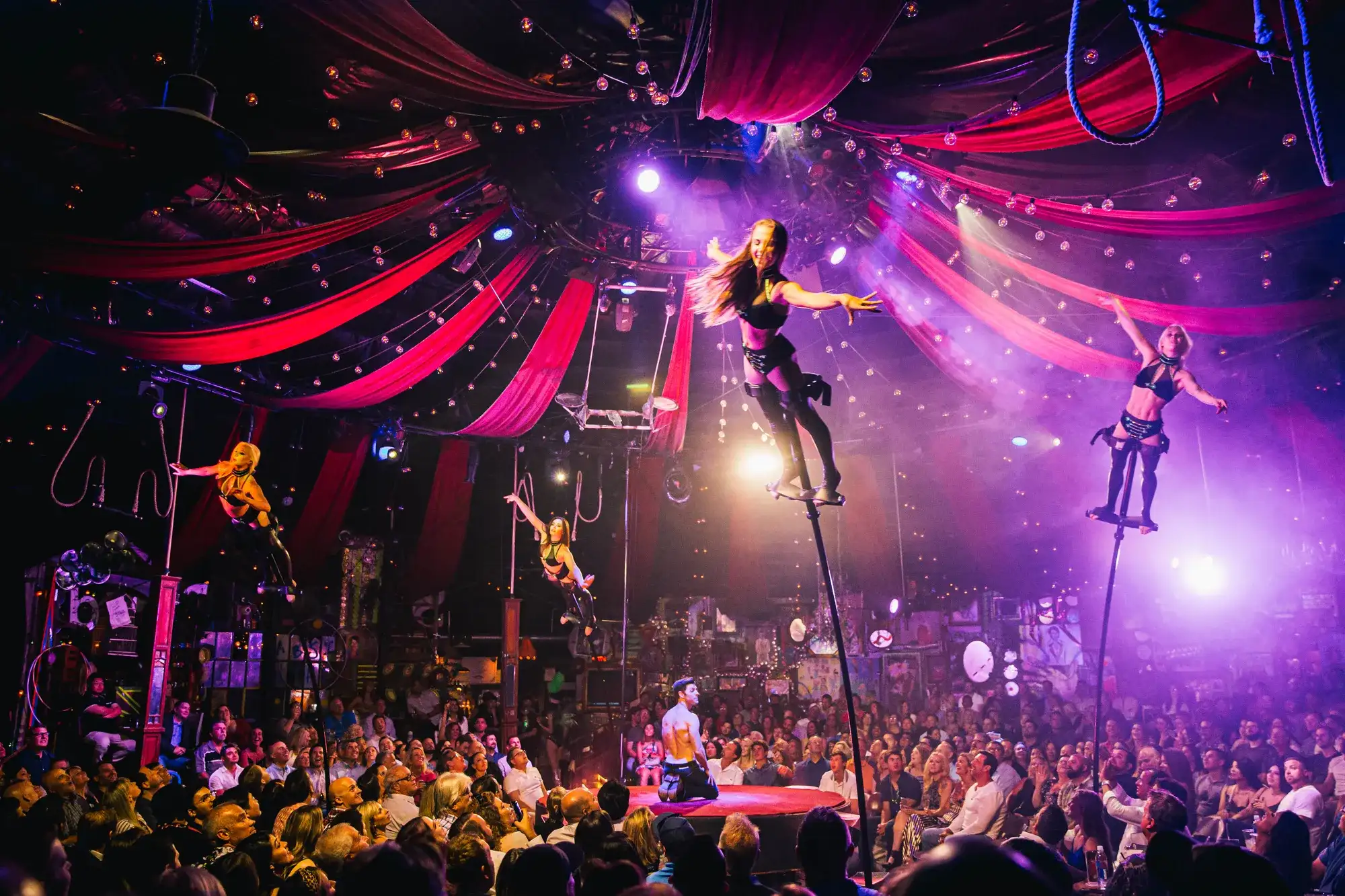
So when I started digging into Absinthe, the long-running Spiegelworld production at Caesars Palace, I expected to admire the acrobatics and move on. World-class acts, 585 seats in the round, fifteen years on the Strip after being booked for six months. Impressive. But the acts are not what kept me up thinking about it.
It was the host.
The Gazillionaire is a gold-toothed, foul-mouthed dirtbag of a ringmaster, played by a rotating cast so the edge never dulls. His crowd work is improvised. He roasts the front row, pulls people onstage, turns the audience into material. Veteran attendees warn first-timers the way you would warn someone about a roller coaster: no one is safe under the tent.
And here is the part that got under my skin. He risks the room. Every single night.
I have spent my career in environments where you cannot afford a dead thirty seconds. Two million guests a year across eight properties. Throughput is survival. Everything I build is choreographed, timed, rehearsed, and backed up. Control is the job. So watching someone walk onstage with no net, look a stranger in the eye, and bet the next five minutes on whatever comes out of his mouth, it fascinates me the way a deep-sea diver fascinates a lifeguard. Same water. Completely different relationship with it.
I remember my own night in that tent. What stayed with me was not any single act. It was a stretch where the audience participation took a turn that surprised even the performers, you could see it land on their faces, and the Gazillionaire rode it like he had been waiting for it all night. That is the thing nobody tells you about effortless crowd work. It is the hardest thing in the room. I have run enough live performance to know that effortless is just mastery with the seams hidden. Ten thousand rooms before that one. The spontaneity is real, but the ability to surf it without wiping out, that is craft.
Because here is what I know from two decades of rooms: the audience can smell fear. The moment a host plays it safe, the moment you feel a performer managing you instead of meeting you, something in the room goes flat. People lean back. They become spectators. And spectators forget.
The Gazillionaire never lets you lean back. You cannot, because you might be next. That danger, that aliveness, is the whole technology of the show. The tent is small on purpose. The acts are close enough to touch on purpose. There is no fourth wall because a fourth wall would be a place to hide, and this show does not hide from anything.
I have seen the other version of this in my own work. The moments guests retell are never the moments we rehearsed the hardest. They are the unplanned ones. The performer who broke character and made a kid laugh. The snow that fell a beat early and turned a plaza into something out of a film. The night the plan broke and something real walked through the crack. I have a quote I come back to: the measure of any experience is not what a guest sees inside the room. It is what they tell someone who was not there. Absinthe understood that before most of us. They built a show where the thing you tell is always what happened to your row, on your night, to people you know. You were not a spectator. You were a co-author. Co-authors tell the story forever.
One reviewer wrote that the whole show feels like stumbling onto a secret meeting of acrobats, dancers, and reprobates, and the first thing you want to do after is tell everyone you know. That sentence is the business model. Fifteen years of it.
So here is my takeaway, and it is a personal one. I am a control artist by trade. I build rooms where nothing is left to chance, because chance at my scale is expensive. But Absinthe reminded me that the opposite is also a discipline. Letting go, on purpose, in front of 585 people, trusting that the room will catch you. That takes more courage than any production budget I have ever managed.
The room is the show. Everything else is just the excuse to get people into the room. And the bravest thing a host can do is walk out with nothing but his nerve and say, in so many words: let’s see what happens tonight.