
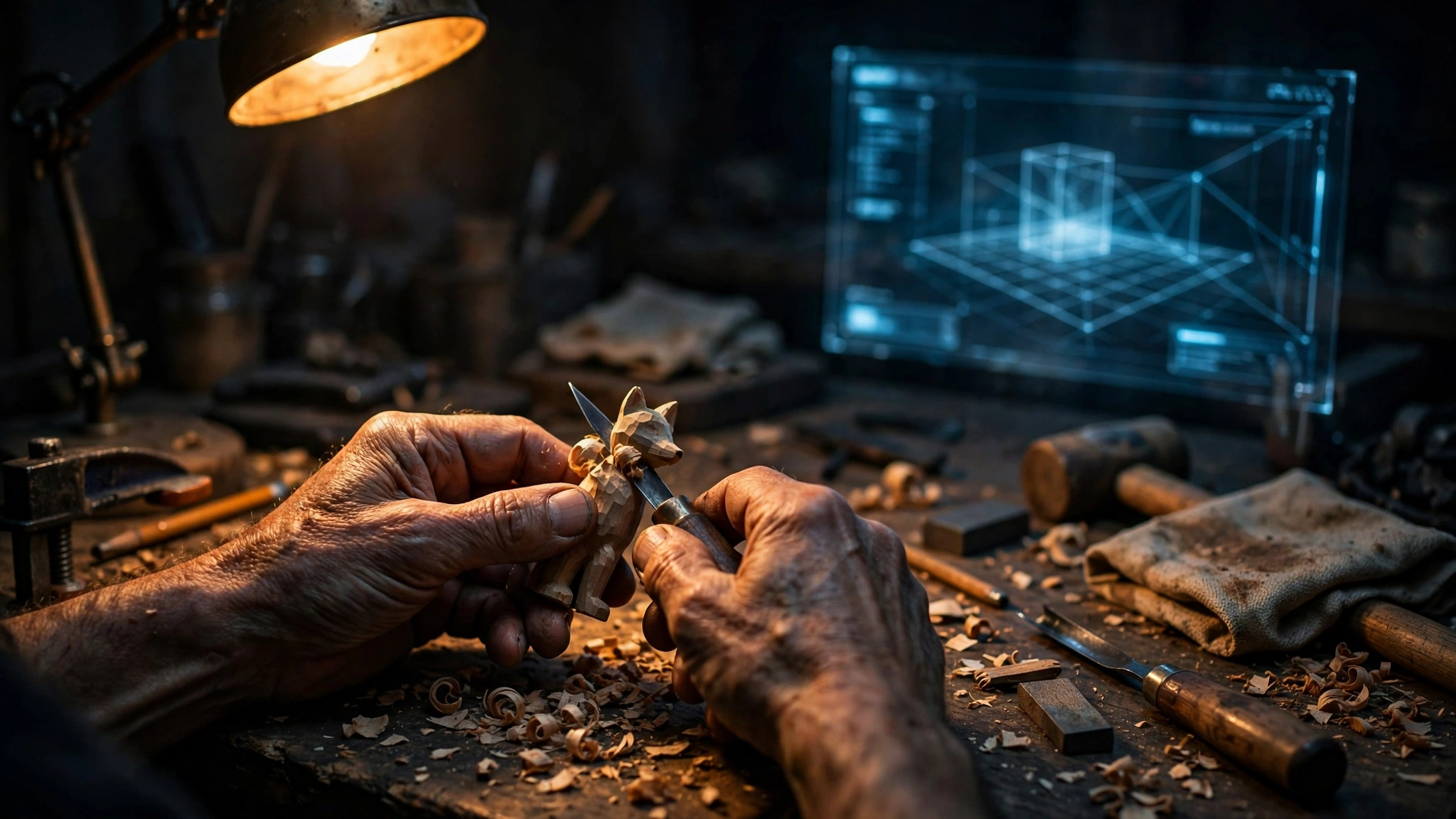
I’ve been hearing the same conversation in every corner of this industry for the last year. AI is coming for the creative process. AI is going to replace designers. AI will make everything look the same.
I get the fear. I’ve felt it too. When you spend your career learning a craft, watching a machine do in seconds what took you weeks is not a comfortable feeling. And a lot of the pushback I’m seeing from creatives right now is real and worth listening to.
But here’s what I keep coming back to. The question was never whether the tools change. The tools always change. The question is where the magic actually lives.
The mouse trained its own model
Disney Imagineering partnered with Adobe this year on custom Firefly Foundry models trained on more than 70 years of Disney’s own design catalog. Three workflows are live. Sketch to rendered concept art. Franchise accurate assets for Frozen, Moana, Cars. 2D concepts turned into 3D prototypes for planning and engineering. Design steps that took months now take days, sometimes hours.
That’s the headline. But the real story is why they did it this way. They didn’t use open models trained on scraped internet data. They trained on their own catalog, their own IP, their own history. Kyle Laughlin, who leads R&D for Imagineering, put it plainly: technology and human creativity can work together responsibly, with creators at the center.
Read that again. With creators at the center.
Disney didn’t build this to replace Imagineers. They built it to make Imagineers faster while keeping the IP locked down tight. That’s not a tool announcement. That’s a moat announcement. Every major operator with an IP library worth anything is going to follow this playbook.
The ops side is already running on it
While the creative side debates, the operations side has moved. Merlin Entertainments rolled out an AI-first guest service platform across 140 plus attractions. Issue resolution went from 75 percent to 95 percent. Likely to recommend went from 8.3 to 9.3. Those are not pilot numbers. That’s the business running on it.
Over in China, Chimelong Spaceship Park deployed more than 300 humanoid robots across entertainment, guest services, hotel ops. Martial arts performances. Directions. Check-in. Multi-turn conversations. At some point the robot stops being a novelty and becomes the attraction itself.
The ops side isn’t coming. It’s here. And nobody is arguing that a faster issue resolution ruins the magic. The magic was never in the hold music.
The counterweight
Chris Stafford, the CEO of Thirteenth Floor, made a point this fall that I keep thinking about. He argued that performers, environmental design, and storytelling can beat expensive technology at creating immersion. Guests are asking for more personal, more participatory experiences. The emotional connection is the product.
He’s right. And this is where the whole debate sharpens into something useful.
The feeling is the product
Here’s my take, and it’s the same one I give my team. Human craft where the guest feels the magic. AI leverage for efficiency everywhere else.
A guest doesn’t care if AI planned their day, shortened their wait, or helped design the queue they walked through. They care if the day felt magical. The feeling is the product. Everything else is plumbing.
That line draws the map. If the guest touches it, feels it, remembers it, a human should have shaped it. If it’s scheduling, forecasting, material estimates, variance analysis, let the machine run. The 72 percent of top parks using AI chatbots, the 23 percent guest spend lift from personalization, the 35 percent cut in wait times from AI virtual queues, that’s all plumbing. Good plumbing matters. But nobody books a vacation for the plumbing.
What this means for the people building
I think AI kills the mediocre middle. The top gets faster. The bottom gets cheaper. And taste becomes the most valuable thing in the room.
If anyone can generate fifty attraction concepts overnight, the value isn’t in the fifty concepts. It’s in knowing which one is right, and why, and how to make a guest feel something when they walk through it. That’s judgment. That’s craft. That’s the part no model has.
The designers who embrace these tools get the throughput of a studio ten times their size and spend the savings on the idea. The ones who refuse get outpaced by people who didn’t. That’s not a threat. That’s just how every tool shift in this industry has ever worked, from CAD to Photoshop to real-time rendering.
So no, I’m not worried that AI ends the creative side of this business. I’m watching it do what every good tool does: strip away the busywork and leave the part that actually matters standing in the open.
The magic was never in the render time. It was never in the hours. It was in the moment a guest walks in and feels something they didn’t expect. That part is still ours.
We just have to keep earning it.
Sources: Disney and Adobe Transform Theme Park Design With AI (Adweek)